
Grant a reward
This is the moment the whole program builds towards. Aster does not decide for you: it tells you the threshold is reached, and you are the one who gives.
The action differs by program type
Free offer, the stamp card
At the threshold, Aster refuses to add another stamp. That is deliberate: it forces you to deal with the reward, and stops a customer collecting fifteen stamps on a card designed for ten.
You record the reward, the counter resets to zero, and the customer starts a new cycle.
Points
No automatic threshold. You decide when a reward is deserved and how many points it costs.
You deduct the chosen number of points, and the remaining balance carries on. The counter does not restart from zero.
Session pass
There is no reward to grant: each visit consumes a session already paid for. When the balance reaches zero, the card becomes unusable until the customer buys another package.
Time pass
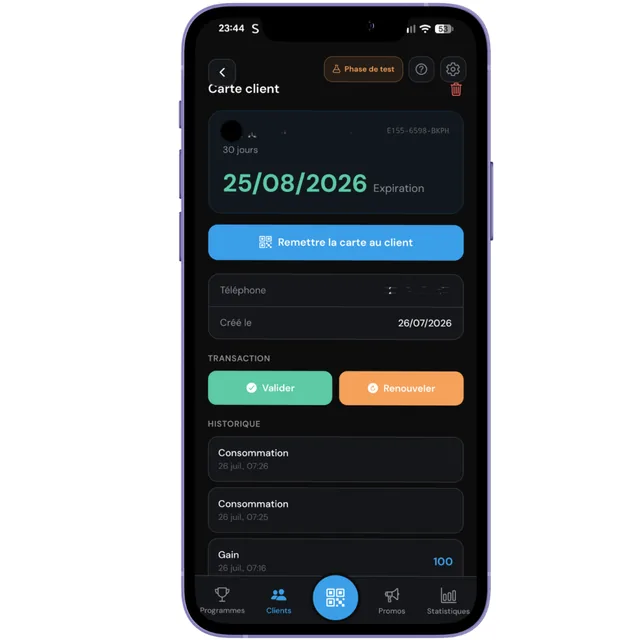
Same logic. You simply check that the pass is still valid. Aster refuses the visit once the expiry date has passed.
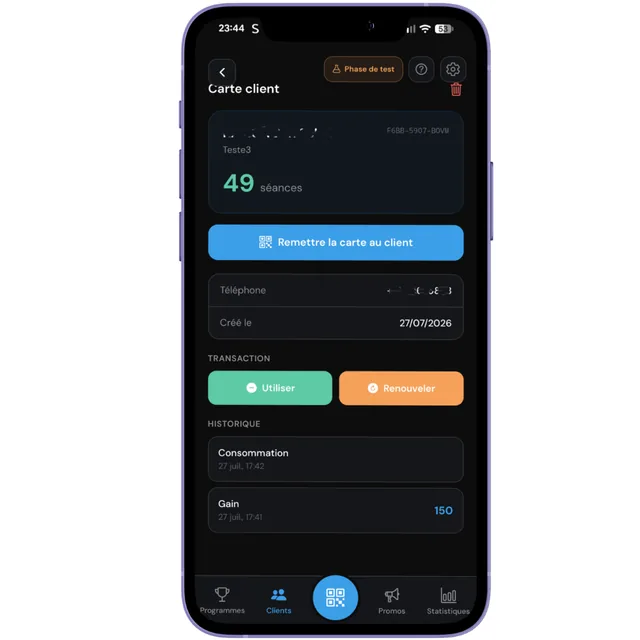
A customer's card page
From the Customers tab, or right after a scan, you open a card. You see its exact state, its visit history, and the available actions.
This is where you record a reward, or top up an exhausted pass.
Top up a pass
When a customer buys another package, top up their existing card rather than creating a new one. Their history is kept, and they keep the same card in their wallet.
For a time pass, the top-up starts from today's date and adds the number of days set by the program.
What can go wrong
The customer has not reached the threshold. If you want to give it anyway, do so at the counter without going through Aster: the counter must stay a faithful reflection of the rule you announced.
You are trying to scan a customer whose card is full. Record the reward first, the counter will reset and scanning will work again.
You are deducting more points than they hold. Lower the cost of the reward or wait until they collect more.